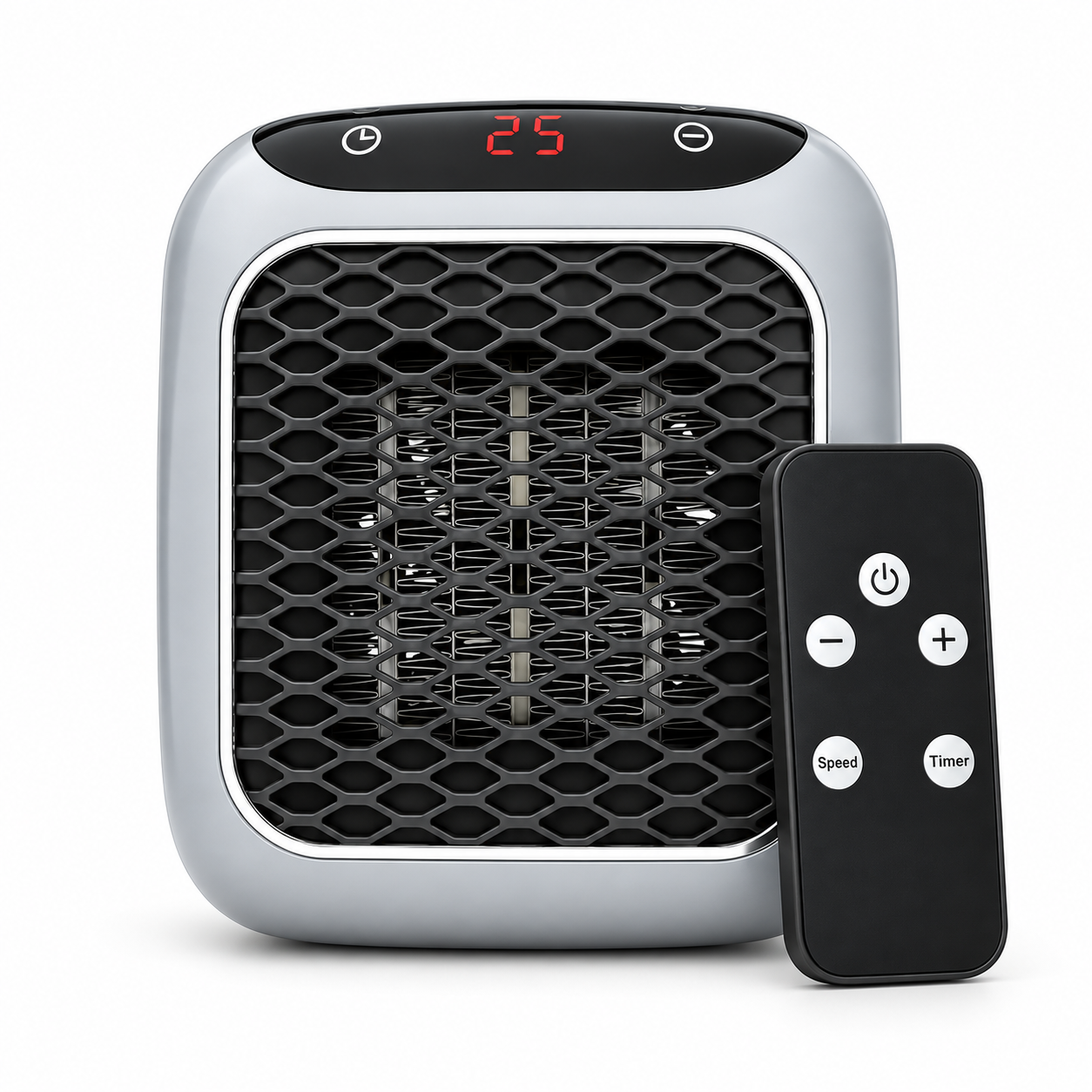
How it works
How RapidHeat warms a room in under five minutes
No mystery and no gimmicks — just ceramic PTC heating, a thermostat that knows when to stop, and a fan quiet enough to sleep beside.
Free shipping in Canada
Tracked delivery in 2–5 business days
30-day money back
Not warm enough? Send it back
Secure checkout
Encrypted card payments
Canadian support
Real people, replies within 24 hours
The short answer
RapidHeat heats with ceramic PTC plates that warm almost instantly and limit their own temperature, while a quiet fan pushes the warmth around the room. A thermostat cycles the heat off once the room reaches your setting, which is why it costs cents an hour instead of dollars. Three separate safety systems — overheat cut-out, tip-over switch and the self-limiting element itself — make it safe to run on a timer overnight.
Ceramic PTC plates instead of a glowing coil
Inside RapidHeat are ceramic PTC (positive temperature coefficient) plates. When electricity passes through them they heat up almost instantly, and a small fan pushes that warmth out into the room. Unlike an old-style metal coil, a ceramic plate self-limits: as it gets hotter, its resistance rises and it naturally draws less power. That is why it does not glow red, does not scorch dust, and cannot run away to an unsafe temperature.
This matters more than any other design choice. The glowing-coil heaters sold every winter hold their element at several hundred degrees until you unplug them — which is what scorches dust, smells after an hour, and makes the casing dangerous to touch. A self-regulating ceramic block reaches its working temperature and stays there, so the outer housing remains cool enough to touch and the air coming out is warm rather than blasting hot.
Convection does the rest
Warm air leaves the front of the unit, rises, cools, and drops back down to be reheated. In a room of up to about 12 m² that circulation loop completes in a few minutes, which is why most people feel the difference within three to five minutes of switching it on.
The fan is what separates a fan-forced ceramic heater from an oil-filled radiator. A radiator warms the air touching its fins and waits for that air to rise on its own — silent and steady, but 20 to 30 minutes before the room feels different. A fan moves the warmth to you immediately, which is the right trade for rooms you dip in and out of: the bedroom before sleep, the office during work hours, the bathroom on a January morning.
The thermostat stops it wasting power
Set your target temperature anywhere from 15°C to 32°C. Once the room reaches it, the heating element cuts out and only the low-power fan continues. When the room drifts a degree cooler, the element kicks back in. That cycling is the single biggest reason a small room heater can cost far less to run than turning up the furnace for the whole house.
In practice, cycling means the heater averages well below its 1,500 W nameplate figure — roughly 0.75 kWh per hour of real use in a typical insulated room. The red LED display on top shows the current setting, and the temperature you choose is the temperature the room holds, not a vague low-medium-high dial guess.
Timer and remote
The 1 to 12 hour timer means you can fall asleep with it on and let it shut itself off. The handheld remote changes temperature, fan speed and timer from the far side of the room, which matters more than it sounds when the heater lives behind a desk or beside a bed.
The useful pattern most Canadian households settle into: the bedroom unit on a two-hour timer at night, the office unit holding 21°C through the workday. Heat appears where you are and switches off where you are not — the exact opposite of paying to warm an empty house.
Safety that is always on
Three independent mechanisms protect against the three realistic failure modes, rather than one switch doing everything:
- Overheat cut-out switches everything off if airflow is blocked.
- Tip-over protection kills power the moment the unit is knocked off level.
- The self-limiting ceramic element cannot exceed its working temperature in the first place.
- The outer housing stays cool enough to touch, which matters with kids and pets around.
- The timer gives you an automatic end point even if you forget.
The one rule that is on you: plug it directly into a wall outlet, never an extension cord or power bar, and keep about 90 cm clear in front of it. That is the cause behind most space-heater incidents in Canada, and it costs nothing to avoid.
The antimicrobial filter
Air drawn into the unit passes through a filter that traps dust and airborne particles before the air is heated and returned to the room. Give it a gentle vacuum every few weeks during heating season and it keeps working. A clogged filter is also the most common reason an overheat cut-out trips, so the two-minute clean protects your heat output too.
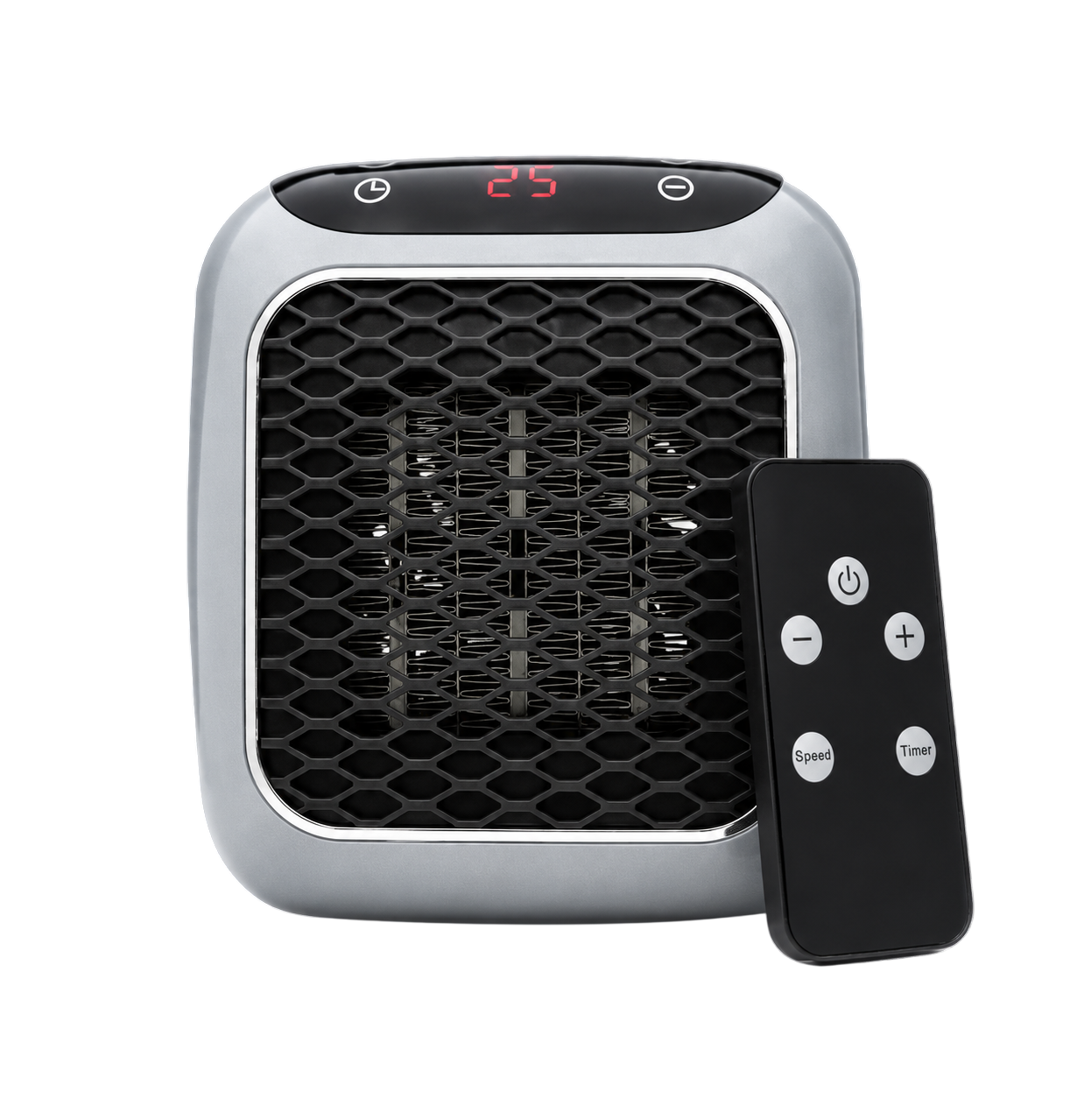
Set up and first use
There is nothing to assemble. From the box to warm air takes about two minutes:
1.Choose the spot
Pick a wall outlet in the room you want to warm, with about 90 cm of clear space in front of the unit and nothing draped over it. Keep it off carpets deeper than a low pile and away from curtains and bedding.
2.Plug straight into the wall
Plug RapidHeat directly into a standard 120 V Canadian wall outlet. Never use an extension cord or power bar — space heaters draw a sustained high current, and cords are the most common cause of heater incidents in Canada.
3.Set your temperature
Use the touch panel or the remote to set a target temperature between 15°C and 32°C. The heater runs at full power until the room reaches it, then the thermostat cycles the element to hold it there.
4.Set the timer if you want one
Choose 1 to 12 hours and the heater shuts itself off when the time is up — useful for falling asleep or warming a home office only during work hours.
5.Clean the filter every few weeks
During heating season, unplug the unit and give the intake filter a gentle vacuum every two to three weeks. Clear airflow keeps the heat output up and the overheat cut-out from tripping.
What it is not
RapidHeat is a supplementary room heater, not a furnace replacement. It will not heat an open-plan great room or an uninsulated garage. For rooms bigger than about 12 m², or for a whole floor, most Canadian customers run two or three units in the rooms they actually use. See the running-cost guide for the maths.
Free shipping across Canada, 30-day money-back guarantee.
See prices & orderWho RapidHeat suits — and who should skip it
A good fit for
- A bedroom, nursery or spare room up to roughly 12 m² (130 sq ft)
- A home office or den where you sit for hours and the furnace underperforms
- A finished basement corner, den or rec-room nook
- Anyone who wants to keep the house thermostat lower and heat one room instead
- Renters and students who cannot install anything permanent
Not the right product for
- Open-plan living and dining areas — one plug-in 120 V heater cannot keep up
- Uninsulated garages, workshops and sheds — you need a hard-wired 240 V unit
- Whole-home heating, or replacing a furnace or heat pump
- Outdoor use, bathrooms with splash exposure, or anywhere it would get wet
- Anyone wanting to run it from an extension cord or power bar — that is unsafe
Ceramic PTC vs the other heating elements sold in Canada
| Ceramic PTC (RapidHeat) | Exposed coil | Oil-filled | Infrared quartz | |
|---|---|---|---|---|
| How it warms | Heats air through a ceramic block and fan | Glowing wire | Heats oil, then the room | Warms objects in its beam |
| Warm-up | 3–5 minutes | Fast | Slow | Instant on your skin |
| Surface temperature | Cool-touch housing | Very hot | Hot | Very hot lamp |
| Self-limiting element | Yes — resistance rises with heat | No | n/a | No |
| Best for | Bedrooms, offices, small rooms | Short bursts | Rooms left heated for hours | Sitting directly in front of it |
Running cost by province
| Province | Typical all-in rate | Cost per hour of use | 4 hrs a day for a month |
|---|---|---|---|
| Quebec | 7.8¢/kWh | 5.9¢ | $7.02 |
| Manitoba | 10.4¢/kWh | 7.8¢ | $9.36 |
| British Columbia | 12.6¢/kWh | 9.5¢ | $11.34 |
| New Brunswick | 14.4¢/kWh | 10.8¢ | $12.96 |
| Newfoundland & Labrador | 14.6¢/kWh | 11.0¢ | $13.14 |
| Ontario | 15.4¢/kWh | 11.6¢ | $13.86 |
| Alberta | 16.5¢/kWh | 12.4¢ | $14.85 |
| Saskatchewan | 18.2¢/kWh | 13.7¢ | $16.38 |
| Nova Scotia | 19.1¢/kWh | 14.3¢ | $17.19 |
| Prince Edward Island | 19.4¢/kWh | 14.6¢ | $17.46 |
Figures assume 1,500 W at roughly 50% thermostat duty cycle (about 0.75 kWh per hour) and 4 hours of use a day for 30 days. Your own rate is on your hydro bill — divide the total charge by the kilowatt-hours used for the truest number.
Ordered on the Monday, warming my basement office by Thursday. Exactly as described, and the remote means I never get up to adjust it.
Common questions
Sources
- Canada Energy Regulator — residential electricity prices across Canada (March 2026)
- Hydro-Québec — comparison of electricity prices in major North American cities
Electricity prices checked September 2026. Rates change — check your own hydro bill for the exact figure. Product figures are the manufacturer's published specifications.
Keep reading
What Canadian customers say
4.8
1,287 verified Canadian buyers
- 5 star84%
- 4 star12%
- 3 star3%
- 2 star1%
- 1 star0%
Marc D.
Winnipeg, MB
I work from a basement office and it was always freezing by 3pm. RapidHeat warms it in about four minutes and I just leave it on the thermostat setting. My hydro bill barely moved.
Helen R.
Halifax, NS
I bought two, one for the bedroom and one for the spare room. You can barely hear them. The timer means it shuts off on its own overnight.
Claire T.
Calgary, AB
Compact, plugs straight into the wall and takes up no floor space. The remote is handy and the automatic shut-off puts my mind at ease with a cat in the house.
Try RapidHeat in your coldest room
Free tracked shipping across Canada, 30-day money-back guarantee and secure card payment.
Order RapidHeat now